Apr . 03, 2024 10:55 Back to list
How to Use Carbon Calculators to Reduce Transportation Emissions
Freight railroads account for just 0.5% of total greenhouse gas (GHG) emissions in the United States, according to the Environmental Protection Agency (EPA), and just 1.9% of transportation related GHG emissions. As more companies focus on their environmental, social and governance (ESG) goals, transportation offers an opportunity to make an impact on the “E” in “ESG.”
Comparing the carbon emissions associated with the shipping modes a company uses can help them identify ways to reduce their environmental impact. A carbon calculator can simplify this process.
The Fastest Way to Calculate Carbon Emissions
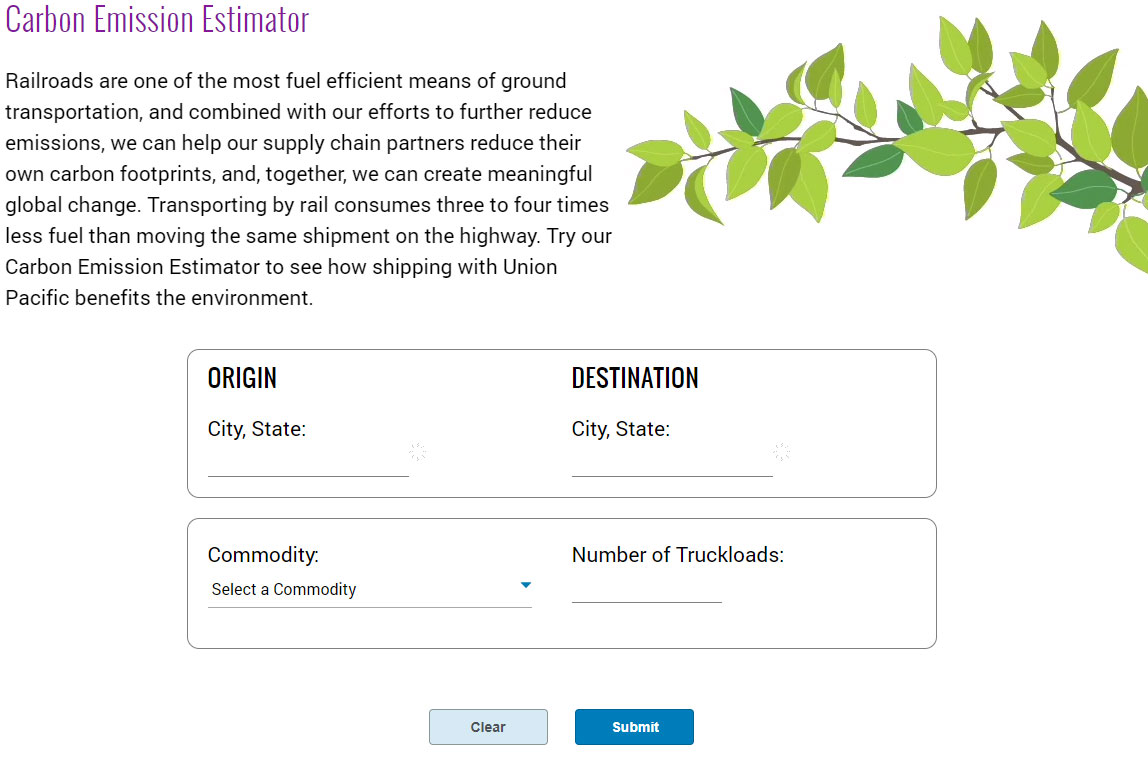
To see the carbon footprint associated with shipping by truck or rail, the fastest and simplest method is accessing a Carbon Emission Estimator. Simply enter the origin, destination, commodity and estimated number of truckloads and click submit.
In addition to seeing the estimated carbon footprint in metric tons, you’ll also learn how much you can reduce carbon emissions by shipping by truck vs rail.
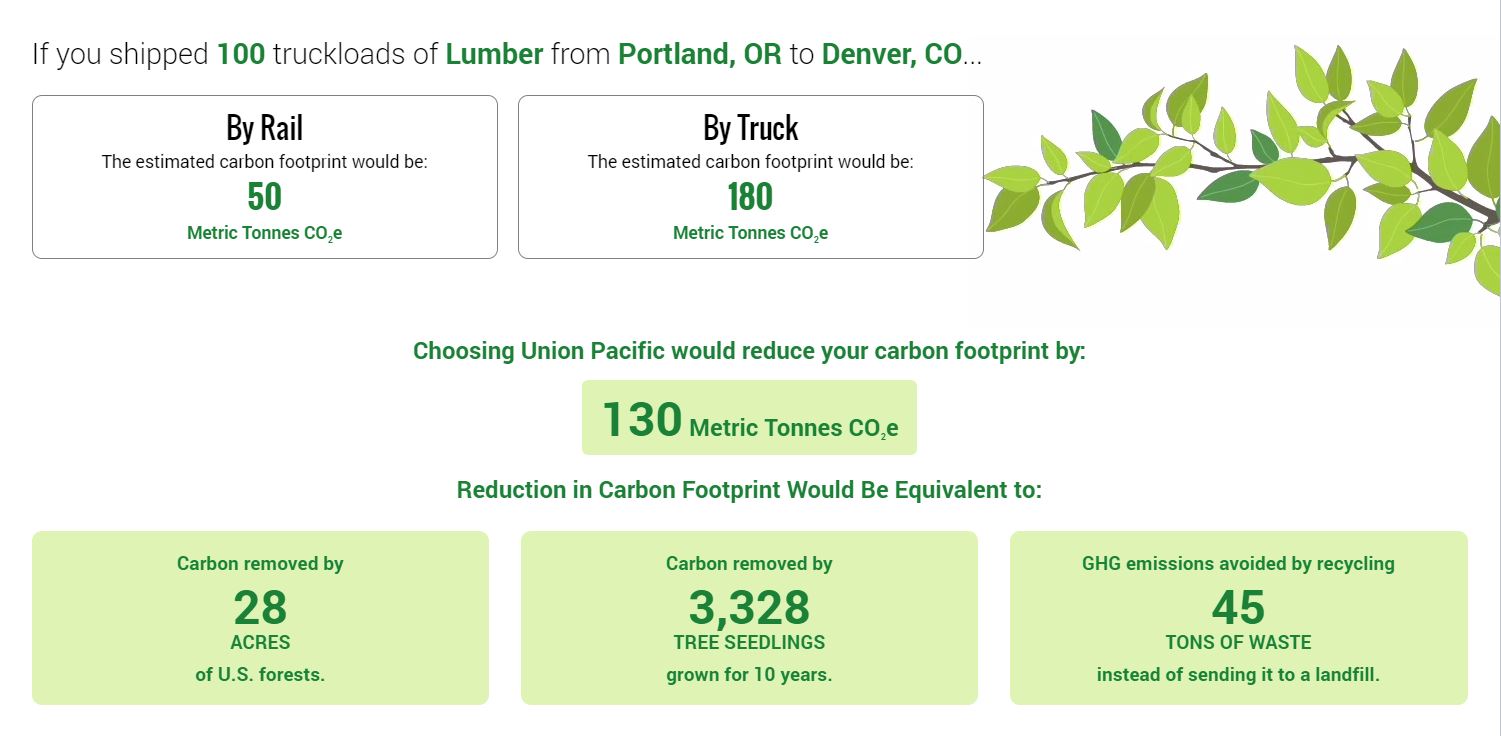
For instance, if a company shipped 100 truckloads of lumber from Portland, Oregon, to Denver, Colorado, by rail, it would reduce the shipment’s carbon footprint by 130 metric tons. That’s equivalent to:
- The carbon removed by 28 acres of U.S. forests.
- The carbon removed by 3,328 tree seedlings grown for 10 years.
- The GHG emissions avoided by recycling 45 tons of waste instead of sending it to the landfill.
The Most Accurate Way to Calculate Carbon Emissions
If you’re a Union Pacific customer, you can get an even more accurate way to calculate the carbon footprint of your shipment(s) with the Carbon Emission Estimator for Customers. Using your User ID, you can:
- Auto populate the mile, weight and truckload fields.
- Edit auto-populated fields based on actual carloads that have moved.
- Generate results by lane (using specific origin and destination cities) or by network (using the total average miles that all rail carloads have moved).
- Use the printer-friendly option to print or email results.
Why Do Rail Shipments Have a Lower Carbon Footprint?
Even though railroads move 40% of U.S. freight, rail shipments account for only 1.9% of U.S. transportation-related greenhouse gas emissions.
The reason rail shipments have a lower carbon footprint is that greenhouse gas emissions are directly related to fuel consumption and trains are the most fuel-efficient way to move freight over land.
Trains offer a more environmentally responsible method of shipping compared to trucks for several reasons:
- One train can carry as much freight as 300 trucks, which reduces highway congestion and GHG emissions.
- On average, U.S. freight railroads can move one ton of freight more than 480 miles per gallon of fuel, making them 3-4 times more fuel efficient than trucks.
- As a result of their improved fuel efficiency, moving freight by train instead of truck reduces GHG emissions by up to 75%.
How Could Shipping by Rail Benefit the Environment?
All of this means the transportation mode companies choose to haul their freight can have a big impact on GHG emissions, and shippers can reduce their environmental impact simply by shipping more products by rail.
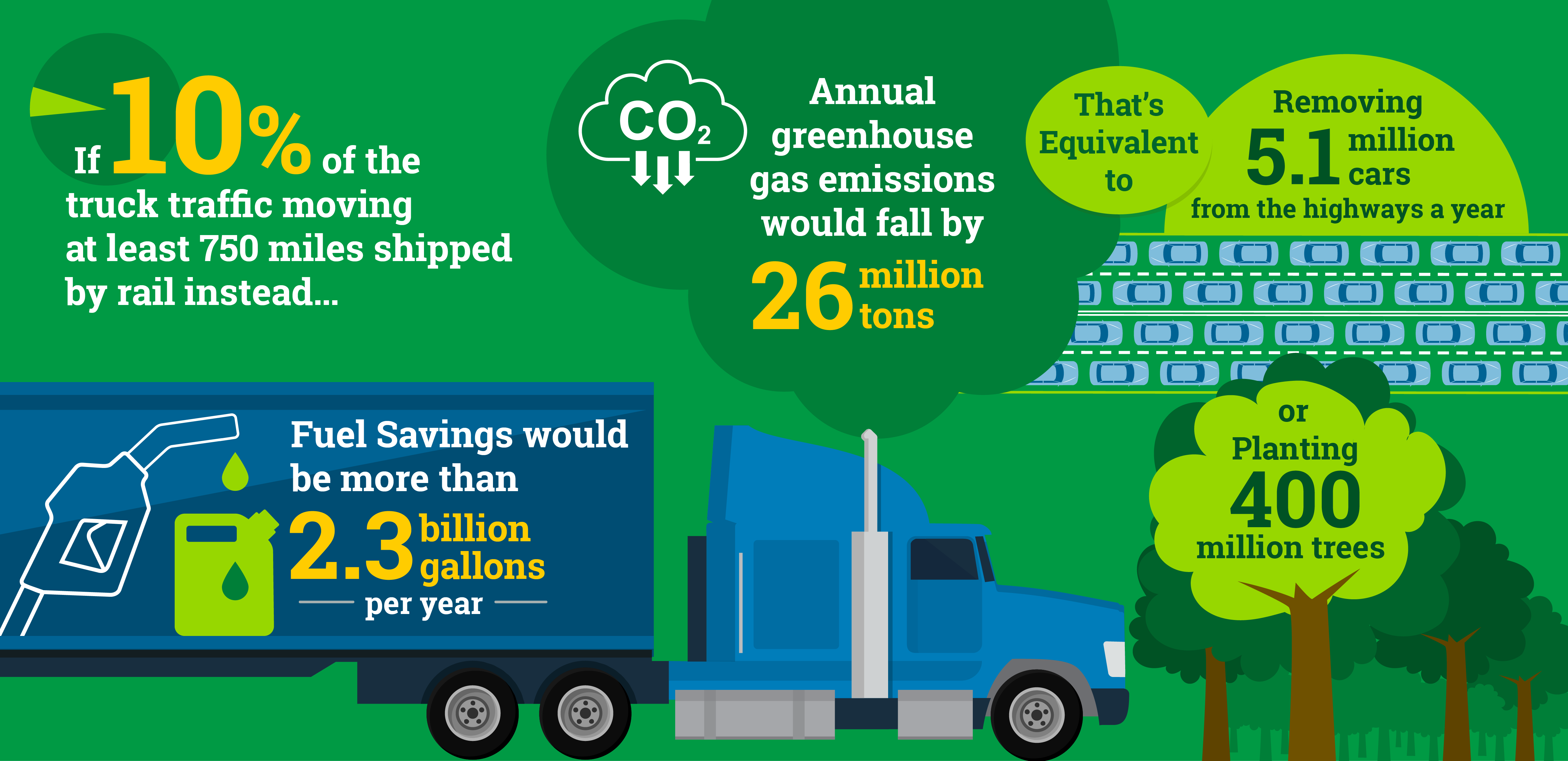
In fact, according to the Association of American Railroads (AAR), if 25% of the truck traffic moving at least 750 miles shipped by rail instead, annual greenhouse gas emissions would fall by approximately 13.1 million tons; If 50% of the truck traffic moving at least 750 miles went by rail instead, greenhouse gas emissions would fall by approximately 26.2 million tons. That would be equivalent to taking 5.1 million cars off the highway or planting nearly 400 million trees.
A List of Greenhouse Gas Calculators
Each of the following carbon emission calculators use slightly different information to calculate emission reductions and present different ways of showing the equivalencies.
- The EPA’s Greenhouse Gas Equivalencies Calculator allows users to convert emissions or energy data into concrete terms, such as the annual CO2 emissions of cars, households and power plants.
- The AAR’s carbon calculator lets users enter the number of rail cars, route, and commodity being shipped to calculate how many tons of carbon dioxide shipping by rail prevents and how many trucks the shipment takes off the road.
- The basic UP Carbon Emission Estimator allows shippers to compare the carbon footprint of rail and truck shipments. Union Pacific customers can also get carbon emission estimates for specific shipments with a User ID. The results show how rail shippers reduce carbon emissions and compare it to the carbon removed by forests, treed seedlings, and recycling waste instead of sending it to the landfill.
- This interactive carbon footprint calculator from the Nature Conservancy looks at emissions on a more personal level: Individuals can enter information in categories like travel, home, food and shopping, compare their individual footprint with the average, and access ways to take action.
 English
  Afrikaans
  Albanian
  Amharic
  Arabic
  Armenian
  Azerbaijani
  Basque
  Belarusian
  Bengali